








Chicken eggs are one of the biggest staples of any kitchen across the globe. Indeed, it is estimated that roughly 4.86 billion chicken eggs are consumed around the world daily, amounting to around 1.78 trillion eggs per year. But why has this specific egg become the average food source for so many people?
While chicken eggs are not the only eggs consumed by humans, they are by far the primary. Indeed, they are so common that most people rarely consider eating eggs from another bird.So, why is the humble chicken egg the most obvious one to eat? Read on to find out.
The idea that humans only eat chicken eggs isn’t entirely true. Many cultures regularly consume other varieties, but chicken eggs have become the dominant commercial choice because they are relatively inexpensive and convenient to produce.
According to the Food and Agriculture Organization of the United Nations (FAO), chickens account for approximately 93% of the world’s egg production. Other poultry species make up the remaining 7%.Modern chickens descend primarily from red junglefowl native to Southeast Asia. Archaeological research places the earliest clearly identified domestic chickens in present-day Thailand between approximately 1650 and 1250 BCE.
Researchers believe that early rice cultivation helped bring junglefowl closer to human settlements. These birds were attracted to cultivated grains (such as rice), and their proximity gradually created opportunities for people to domesticate them.
Early chickens weren’t originally reared for food. Historical evidence suggests they were used for rituals and cockfighting, while their usefulness as a dependable agricultural food source developed over time.
As agricultural communities expanded and trading networks developed, domestic chickens traveled beyond Southeast Asia. Archaeological evidence places them in Mediterranean Europe and Ethiopia by approximately 800 BCE.
Chickens offered an appealing way for households to produce food without keeping enormous animals. Their relatively small size made them manageable, while eggs provided a recurring harvest.
Wild red junglefowl hens typically produce around a dozen eggs during their breeding season. But generations of selective breeding transformed domestic chickens into birds capable of producing hundreds every year.
Commercial laying hens can produce approximately 250 to 300 eggs annually under favorable conditions. This astonishing productivity allows farmers to maintain a consistent supply throughout much of the year.
Farmers gradually favored chickens that laid more eggs and used feed efficiently. Modern breeding programs strengthened those characteristics and helped turn egg production into a highly specialized agricultural industry.
A successful egg farm depends on producing enough eggs to cover feed and operating costs. Modern laying hens are particularly valuable because breeding has improved their feed efficiency.
Commercial farmers need dependable supplies rather than occasional harvests. Specialized laying hens provide comparatively predictable production, which makes it easier to fulfill supermarket orders and distribute year round.
The affordability of chicken eggs also reflects decades of improvements in breeding and large-scale production. Chicken egg farms benefit from established supply chains and an enormous market of regular customers.
Once chicken eggs became the standard product, supermarkets organized their purchasing and distribution systems around them. This established market makes unfamiliar alternatives much harder to introduce at similarly competitive prices.
A typical chicken egg weighs approximately 2.1 ounces (58 grams), which makes it practical for individual portions and everyday cooking. Larger eggs can complicate recipes, while smaller varieties require more handling.
Generations of home cooks have also developed recipes around chicken eggs. Their familiar flavor and dependable cooking properties have made them the default ingredient for breakfast dishes and baking, for example.
Different birds produce eggs with considerably different sizes, shell characteristics, and culinary uses. Duck eggs, for example, are widely consumed in parts of Asia and are also enjoyed elsewhere. Their larger yolks and richer flavor make them particularly appealing for certain baked goods.
But despite their culinary advantages, ducks can waste more feed when raised in confinement. The FAO identifies this inefficiency as one reason that duck eggs can cost more to produce.
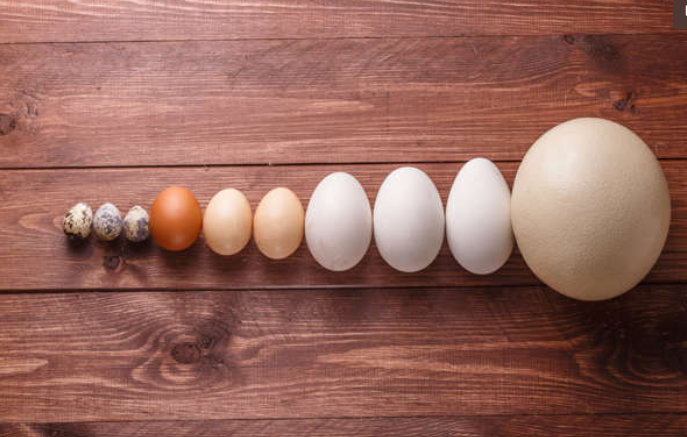
Quail eggs are also quite popular in many countries, and are often eaten as appetizers or garnishes. But their small size, averaging approximately 0.39 ounces (11 grams), means several are needed to equal one chicken egg.
Goose eggs can weigh more than twice as much as chicken eggs. However, geese generally lay far fewer eggs annually (only between 30 and 50), which makes large-scale production less attractive for everyday consumption.
Similarly, turkey eggs also tend to be absent from supermarkets because of how expensive and inefficient they are to produce. Turkeys only average around 70 eggs per year, and since they are twice as large as chickens they need twice as much food, land, and housing.
Guinea fowl also produce edible eggs, but traditional breeds are less prolific than commercial chickens. Research from the FAO has found that some varieties produce approximately 38 to 51 eggs annually.
Ostrich eggs are among the largest laid by living birds, equivalent to around 24 large chicken eggs in volume and nutrition. This makes them impressive culinary novelties, but there are a number of reasons why it is unfeasible to cultivate them.
Ostrich eggshells are exceptionally strong and thick, and opening them typically requires a drill or hammer. Additionally, ostriches require a massive amount of resources to rear, not to mention that they are incredibly dangerous and capable of inflicting fatal injuries.
Humans have also consumed eggs from birds outside mainstream poultry farming. But collecting wild eggs raises concerns over conservation, particularly when harvesting disrupts nesting populations or threatens protected species.
Duck, goose, and quail eggs contain valuable nutrients, but their proportions differ. Nutritional comparisons show variations in fat, protein, vitamins, and minerals rather than one universally superior variety.
Research comparing eggs by weight finds that duck eggs generally contain more fat than chicken eggs, which could possibly add to the reason why chickens are favored more often. The vitamin B12 and iron content of duck eggs can also be higher.
Although quail eggs are sometimes promoted as unusually nutritious, scientific comparisons show that, gram-for-gram, they are nearly identical in nutrition to chicken eggs.
Alternative eggs can already be found in markets around the world, particularly among specialty food providers. And additional consumer interest could support expansion.


 Ren Ecosystem