








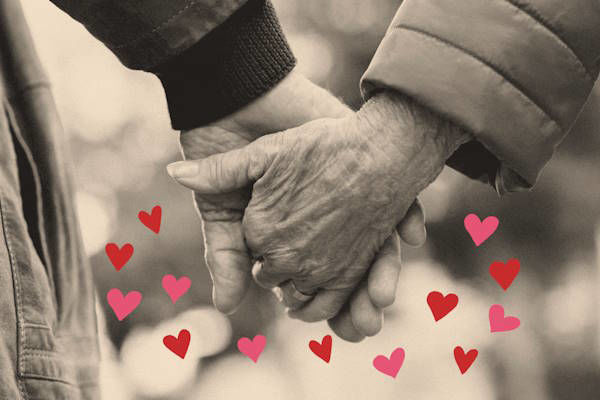
But the research also suggests something far more profound about our need for connection.
“If you really understand hand-holding — what it is and how it has its effects — you begin to understand just about every single facet of what it is to be a human being,” said James Coan, a clinical psychologist and director of the Virginia Affective Neuroscience Laboratory at the University of Virginia. “It expresses all the things that we are for each other.”
The hand-holding experiments
Coan and his team have conducted several experiments on the effects of holding hands. The first set involved 16 married women who were placed in an MRI brain scan and confronted with the threat of an electric shock. The brain scans showed that when these women held a stranger’s hand, it lowered the stress of being shocked.
But the effect was even more pronounced when they held their husbands’ hands. Notably, the quality of the relationship mattered too. The benefit of holding hands was strongest among women with the highest scores on marital quality tests. Later studies showed reduced stress in other kinds of relationships, including people who were dating or were just friends.
According to Coan, the findings suggest that holding hands actually helps the brain offload the work of confronting stress. So when you reach out to hold a loved one’s hand in a difficult time, it’s like you’re sharing the burden with them.
Why do people hold hands?
During the experiments, Coan and his team kept bumping into an odd finding. Emotional regulation had been established by many in the field to be managed by the prefrontal cortex. It’s the part of the brain that helps us control our instincts and see reason — telling you, “Relax, it’s only a movie!” when you’re watching a horror film, Coan explained.
Coan hypothesized that holding the hand of someone close to them would cause an increase in activity in the prefrontal cortex as the participant relaxed and felt more secure. With more activity in the prefrontal cortex, he thought, less emotional activity — like those involved in fear or anxiety — would occur elsewhere in the brain.
But that’s not what happened.
When couples held hands, Coan did observe a decrease in all the emotional regions of the brain as he had expected. However, in experiment after experiment, there was no associated increase in prefrontal cortex activity — instead, there was a decrease.
What was going on?
At first, Coan couldn’t account for what part of the brain was responsible for the participants’ stress relief when they held hands. It was as if people were getting snacks out of the vending machine without paying any money.
Finally, he arrived at a new conclusion: What if he had gotten the baseline and experimental states backward? Maybe the brain didn’t perceive holding hands as something new he was adding to a baseline of being alone. What if our neuropsychological baseline was feeling connected to someone? Perhaps feeling alone was the deviation all along — one that would require the metabolically expensive activation of our prefrontal cortex to cope.
“To the human brain, the world presents a series of problems to solve,” Coan said. “And it turns out being alone is a problem.”
He called this phenomenon social baseline theory: It’s the idea that the human brain expects access to relationships and interdependence because without them, the world’s problems are mammoth and we need to expend so much more physiological and psychological effort. But when we know we’re not alone — as is conveyed through holding hands — it’s as if we can access snacks freely with no vending machine at all.


 Ren Ecosystem