








4 mins read//
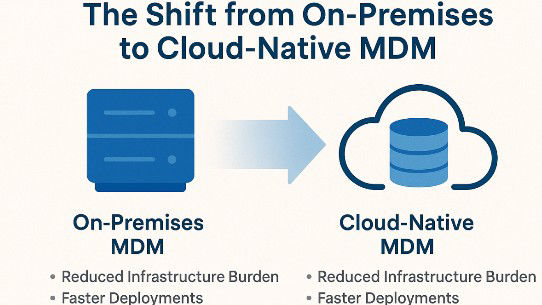
As technology companies race to innovate and scale, one transformation is quietly redefining data strategy across the industry: the shift from traditional on-premises Master Data Management (MDM) to cloud-native MDM solutions. This evolution isn't just a technical migration—it's a strategic breakthrough in how organizations harness, govern, and leverage their most valuable asset: data.
On-Premises MDM: The Limitation of Yesterday
For years, tech companies relied on on-premises MDM platforms to support core business functions—centralizing customer, product, and operational data within tightly controlled datacenters. While reliable, these legacy systems imposed critical constraints:
- High Infrastructure Costs: Every new business domain, geographic expansion, or product launch meant more hardware, licenses, and IT resources.
- Slow Deployment: Installing and configuring MDM took months, often delaying critical business initiatives.
- Limited Flexibility: Integrating new data sources or partners meant time-consuming, specialized development.
- Capacity Bottlenecks: Scaling up required physical upgrades and downtime, making rapid response impossible.
The Cloud-Native MDM Revolution
Cloud-native MDM systems flip the paradigm—delivering agility, speed, and virtually limitless scale. Here’s how the transition is unlocking new possibilities:
1. Reduced Infrastructure Burden
- No Hardware Hassle: Cloud MDM eliminates the need for on-site servers, storage, and networking hardware. Infrastructure is managed by the cloud provider, freeing IT teams from maintenance and upgrades.
- Costs Scale with Usage: Pay-as-you-go models let companies ramp up or down based on business needs—avoiding sunk costs tied to underutilized infrastructure.
2. Faster, Seamless Deployments
- Rapid Onboarding: Launch new MDM environments in days, not months. Cloud-native applications use pre-built connectors, templates, and APIs to integrate with business systems almost instantly.
- Continuous Updates: Platforms are upgraded automatically, ensuring the latest features and security without disruptive patch cycles.
3. Scaling Without Limits
- Instant Elasticity: Add new data domains (customers, products, suppliers), integrate newly acquired companies, or support sudden spikes in volume—without capacity constraints or performance degradation.
- Global Reach: Deploy MDM instances across regions in minutes, support local compliance requirements (data residency, privacy), and synchronize records globally.
4. Accelerating Innovation and Business Value
- API-Driven Integrations: Easily connect MDM with cloud analytics platforms, AI engines, IoT data streams, and digital customer apps—empowering real-time, business-wide intelligence.
- Hybrid Workforce Enablement: Secure, role-based access means that business users, partners, and remote teams can work collaboratively from anywhere
5. Simplified Governance and Compliance
- Centralized Policy Enforcement: Standardize and automate data quality, stewardship, and privacy rules across global operations.
- Built for Change: Cloud-native MDM adapts quickly to regulatory shifts (GDPR, CCPA, industry standards), ensuring ongoing compliance as business requirements evolve.
Real-World Impact: Tech Sector Success Stories
Global SaaS Provider: Moved from on-prem MDM to the cloud, reducing deployment times from six months to two weeks, supporting 24/7 global operations, and slashing infrastructure overhead by 70%.
Device Manufacturer: Launched new product lines in multiple regions with instantaneous data harmonization. Cloud MDM enabled real-time supply chain visibility and accelerated market entry.
Fintech Leader: Centralized customer and risk data across North America and Europe, ensuring compliance and business continuity—while scaling to handle double-digit growth with zero downtime.
Best Practices for a Successful Shift
- Assess Your Data Landscape: Map existing systems, domains, and future growth needs.
- Choose Future-Ready Platforms: Prioritize cloud-MDM solutions with API-first, low-code integration and robust governance capabilities.
- Plan for Hybrid Integration: Ensure seamless migration from on-premises sources, and integrate legacy data until cutover is complete.
- Engage Stakeholders Early: Coordinate across IT, compliance, business units, and partners for holistic adoption and buy-in.
- Build for Continuous Optimization: Use cloud agility for ongoing improvement—refine data models, governance, and business processes as you scale.
The Takeaway
The shift from on-premises to cloud-native MDM redefines what's possible:
- Cost-effective scale
- Lightning-fast deployment
- Agility for new markets and products
- Continuous, global compliance
For technology companies, cloud-based MDM is more than an upgrade—it’s the launchpad for rapid growth, smarter innovation, and resilient data-driven success.


 Ren Ecosystem