








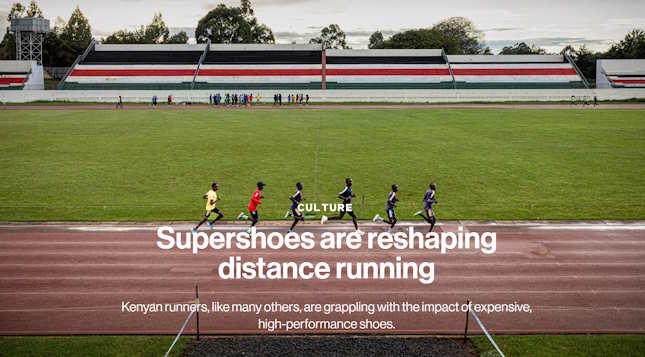
Part 1 of 2. (Photo: Athletes train at Kipchoge Keino Stadium in Eldoret, Kenya. Credit: Patrick Meinhardt)
The track at Moi University’s Eldoret Town Campus doesn’t look like a facility designed for champions. Its surface is a modest mix of clay and gravel, and it’s 10 meters longer than the standard 400. Runners use a classroom chair to mark the start and finish. Yet it’s as good a place as any to spot the athletes who make Kenya the world’s greatest distance-running powerhouse.
On a morning in January, nearly a hundred athletes, including Olympic medalists and winners of major marathons, have gathered here for “speedwork”: high-intensity intervals that the best runners make look effortless. The track is packed with so much talent that it is easy to miss the man of the moment, a gangly runner in a turquoise shirt and thick-soled Nike shoes. In just over a year, Kelvin Kiptum had gone from virtual unknown to global phenom, running three of the seven fastest marathons in history and setting the official men’s world record, 2:00:35, in Chicago in October 2023. On this day, he was less than three months out from his next race, in Rotterdam, where he planned to try for something once unthinkable: completing the 26-mile, 385-yard event in less than two hours.
Although fans were left in awe by Kiptum’s Chicago triumph, not everyone celebrated the shoes that had propelled him to victory. Since 2016, when Nike introduced the Vaporfly, a paradigm-shifting shoe that helped athletes run more efficiently (and therefore faster), the elite running world has muddled through a period of soul-searching over the impact of high-tech footwear on the sport. The Vaporfly was only the beginning. Today, most major brands offer multiple versions of the “supershoe”—a technology that combines a lightweight, energy-returning foam with a carbon-fiber plate for stiffness. “Superspikes” based on a similar concept are now widely used on the track as well. Performances have adjusted accordingly. Since 2020, according to the sport’s governing body, World Athletics, runners wearing so-called advanced footwear technology have broken all road and outdoor track world records in distances from 5,000 meters to the marathon—a concentration unlike any in the sport’s modern history.
The steady stream of footwear innovation has brought unending speculation over which brand’s shoes are best. Critics say that places too much emphasis on gear at the expense of runners’ ability.
Some of the most impressive feats have come in the marathon. In a 2019 exhibition that wasn’t eligible for records, Kenya’s Eliud Kipchoge covered the distance in an astonishing 1:59:40. Last September, Ethiopia’s Tigst Assefa lowered the women’s world record by more than two minutes in Berlin, running 2:11:53 in the ultralight Adidas Adizero Adios Pro Evo 1, a shoe designed to be worn only once. For his own record two weeks later, Kiptum wore the slightly heavier yet uber-bouncy Nike Alphafly 3. The uninitiated could have been forgiven for thinking the white platform shoes, which almost looked designed for walking on the moon, belonged on a sci-fi set rather than the streets of Chicago.
To some, this is all a sign of progress. In much of the world, elite running lacks a widespread following. Record-breaking adds a layer of excitement. And as I’d hear repeatedly from top athletes and coaches in Kenya, the shoes have benefits beyond the clock: most important, they help minimize wear on the body and enable faster recovery from hard workouts and races.
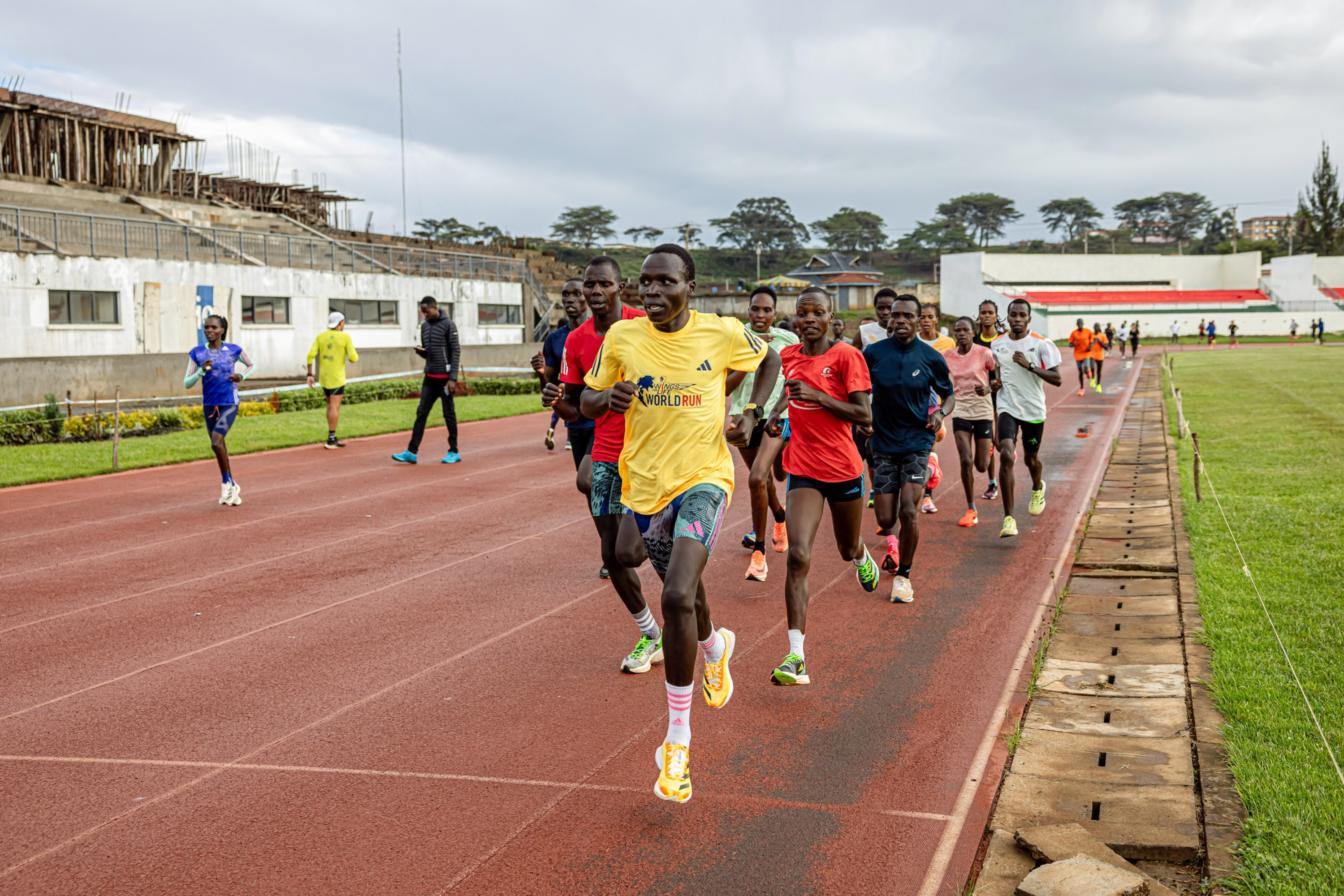
Most marathoners prefer the clay and gravel track at Moi University’s Eldoret Town Campus but shift to Kipchoge Keino Stadium (shown here) when it rains. PATRICK MEINHARDT
Still, some argue that they’ve changed the sport too quickly. Not only has it become hard to compare new records fairly with old ones, but the steady stream of footwear innovation has brought unending speculation over which brand’s shoes are best, and critics say that places too much emphasis on gear at the expense of runners’ ability. Laboratory research also suggests that some runners get a greater boost from the technology than others, depending on their biomechanics. Ross Tucker, a South African sports scientist and outspoken supershoe critic, has argued that these differences make it effectively impossible to “evaluate performances between different athletes independent of this nagging doubt over what the shoes do.”
How much of Kiptum’s success was due to his talent, training, drive, and mental toughness—and how much to his body’s responsiveness to Nike’s tech? It’s difficult to know—and, tragically, he’s not around to offer input. A few weeks after I saw him in Eldoret, a city of several hundred thousand that serves as Kenya’s unofficial running capital, he and coach Gervais Hakizimana were killed in a late-night car crash en route to the nearby town they used as a base for training.
Shoes were the last thing on the mind of Kenya’s running community in the wake of Kiptum’s death. Yet his dramatic rise offers a window into their significance. Although the shoe-tech revolution has affected runners the world over, in few places has its effect been more pronounced than Kenya, where running is not only a sport but an exit strategy from a life of poverty. In this sense, the new high-tech shoes are something of a mixed blessing, giving a boost to established runners with company sponsorships while forming an obstacle to those still pining for their big break. Even the cheapest models here sell for well over $100—no small sum for young people who mostly come from disadvantaged backgrounds.
Today most Kenyan athletes, whether beginners or household names with six-figure shoe contracts, have come to accept that there’s no turning back—that even the most elemental of sports is not immune to scientific innovation. Still, the new shoes are transforming the sport in myriad ways, throwing new variables into training and racing, exacerbating inequalities between athletes, and altering the collective imagination of what performances are possible. They’re also writing a new, tech-fueled chapter to one of the sports world’s most unlikely tales: how a small corner of one African country became such a dominant force in running, and how running, in turn, became the stuff of dreams for so many of its youth.
Engineered to Fly
Supershoes are carefully optimized to help runners go the distance
Beneath the boat-like exterior, supershoes boast a variety of features designed to lower the energetic cost of running, allowing athletes to go faster and help them endure the strain of a long-distance race.
The most crucial feature is the (often proprietary) foams that are used to construct parts of the sole. These absorb the impact of the foot and return energy from each foot strike back to the runner. Some use other features, like the orange “air pod” in the Nike Alphafly 3 (bottom), for an added bounce.
Bounciness alone would not provide much advantage—today’s foams are so soft and thick (World Athletics allows up to 40 millimeters in competitions) that without additional support they would make the feet highly unstable. To give the shoes structure, manufacturers add rigid components like carbon-fiber plates or rods, typically sandwiched between layers of foam.
These rigid parts and foams are combined with wafer-thin mesh uppers to create shoes that are increasingly ultralight: the Adidas Adizero Adios Pro Evo 1 (top), released in 2023, weighs just 4.9 ounces (measured in the men’s size 9). Lighter shoes also reduce the energy expended with each stride—enabling runners to move at a given pace with less effort.
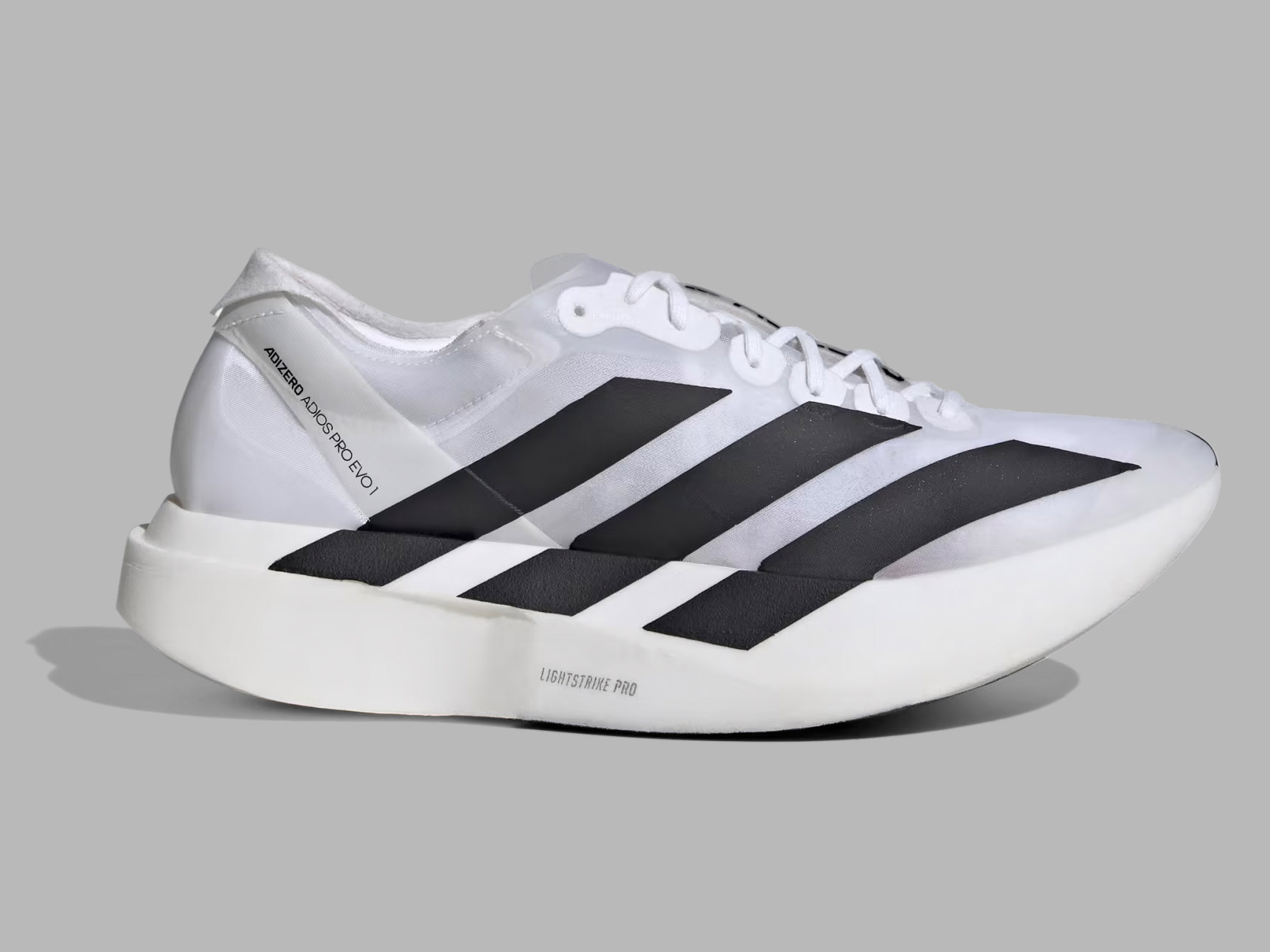
The Adidas Adizero Adios Pro Evo 1 was designed to be worn just once. COURTESY OF ADIDAS
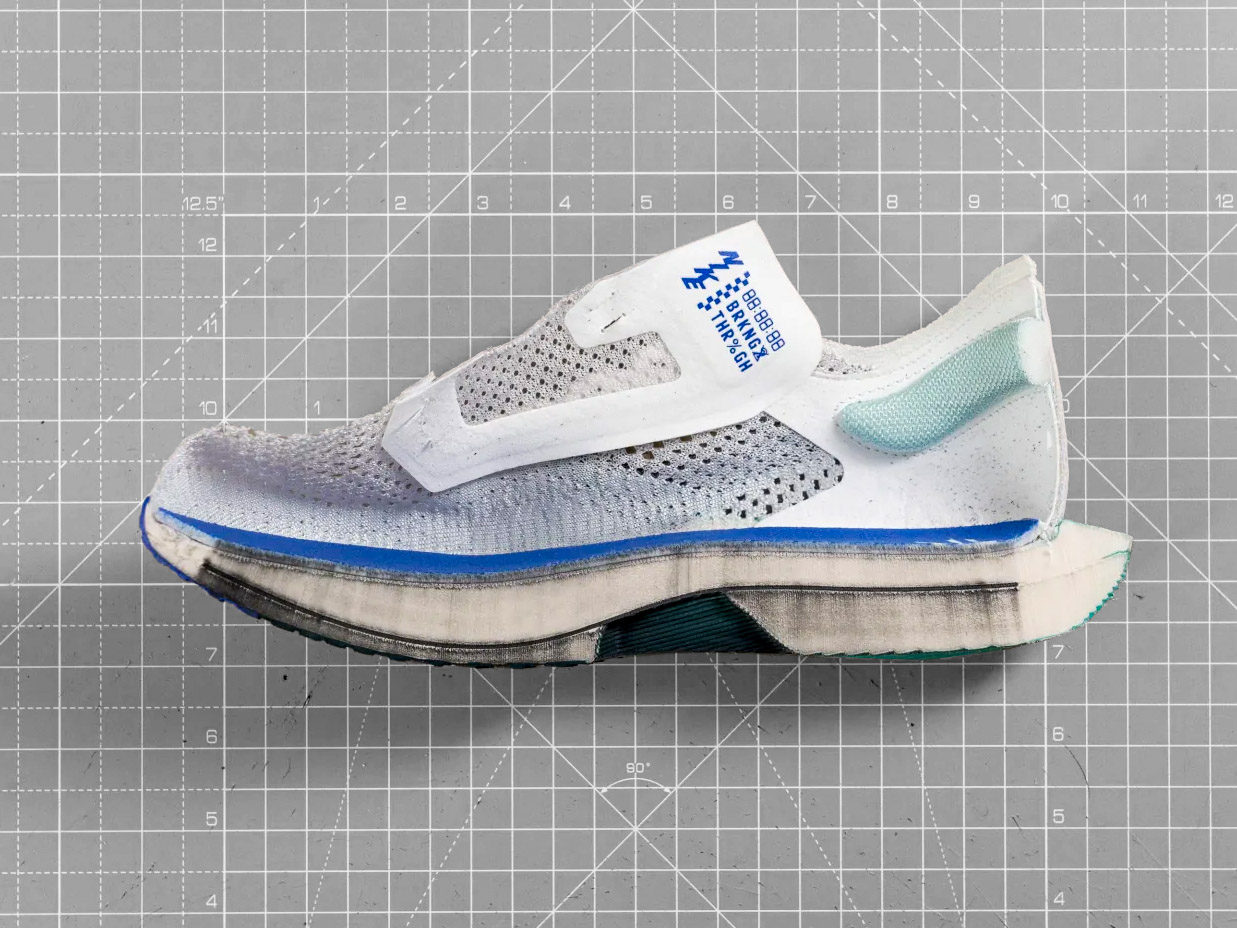
The Nike Vaporfly was the first shoe to combine energy-returning foam with a carbon-fiber plate for stiffness. RUNREPEAT.COM
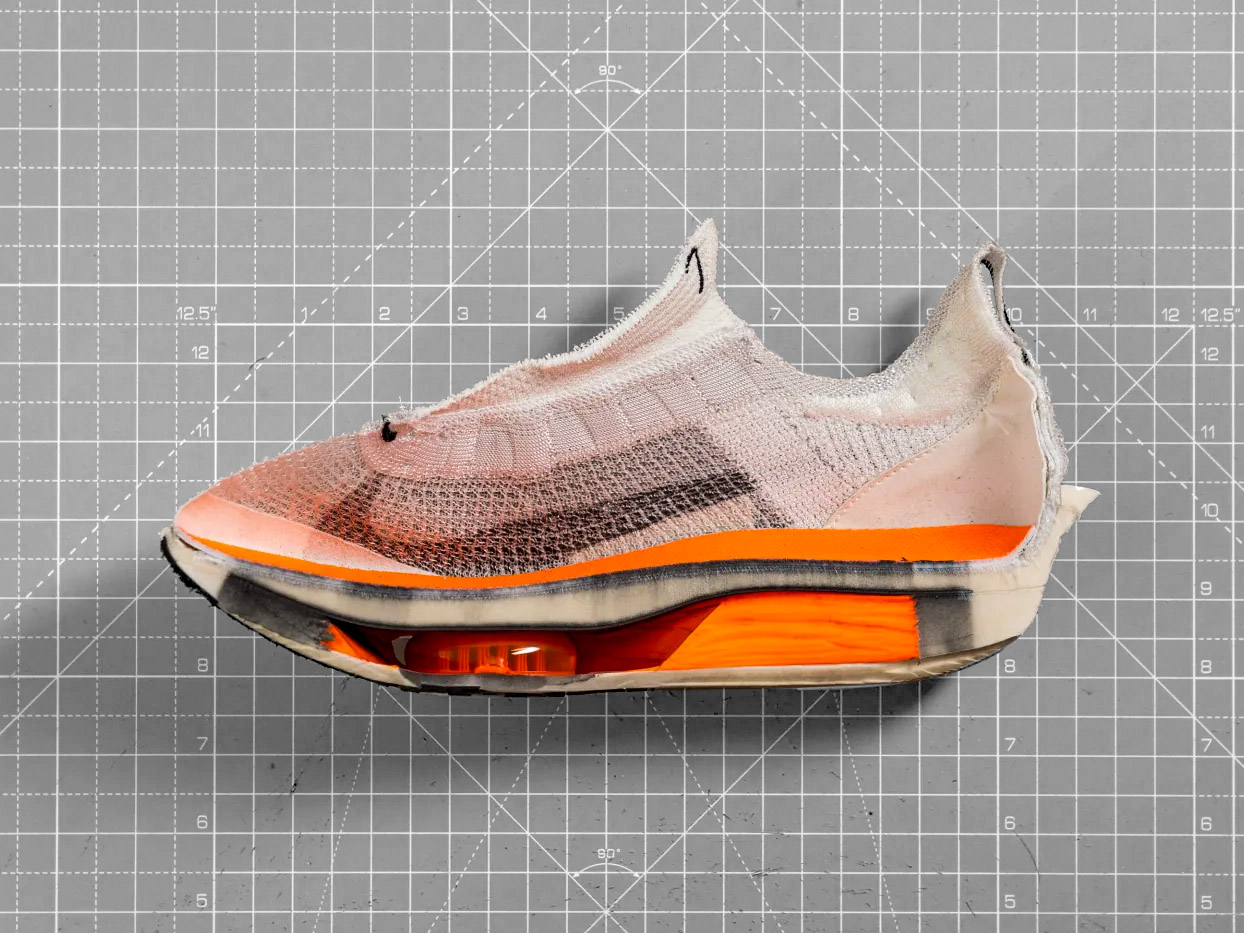
The late Kelvin Kiptum set the official men’s world record in Chicago last October while wearing Nike’s Alphafly 3. RUNREPEAT.COM
A bounce in the step
To understand the impact of shoes on running performance, it’s helpful to think of the human body as a vehicle. In a long-distance event like the marathon, competitors are limited by three physiological factors. VO2 max, the maximum amount of oxygen the body can absorb, is akin to an engine’s horsepower—it effectively measures the upper limits of a runner’s aerobic capacity. Lactate threshold, the point at which lactic acid accumulates in the blood faster than the body can remove it, is like the redline on a dashboard tachometer—it tells you how close you can run to your VO2 max without succumbing to exhaustion. The third parameter, running economy, describes the rate at which a runner expends energy, similar to gas mileage. A light, aerodynamic coupe will use less fuel, or energy, to travel at a given speed than a hulking SUV. So too will a lithe, efficiently striding marathoner.
It is running economy that’s affected by footwear—most obviously when it comes to weight. As a leg in stride moves through space, added weight closer to the end (i.e., the foot) has a greater energetic cost than weight closer to the center of gravity. Soles made with foams that are soft, or compliant (good at storing mechanical energy), and resilient (good at returning it) can also lead to significant energy savings. Studies have shown that shoes with stiffening elements, like plates, can improve running economy as well, by reducing the muscular effort of the feet.
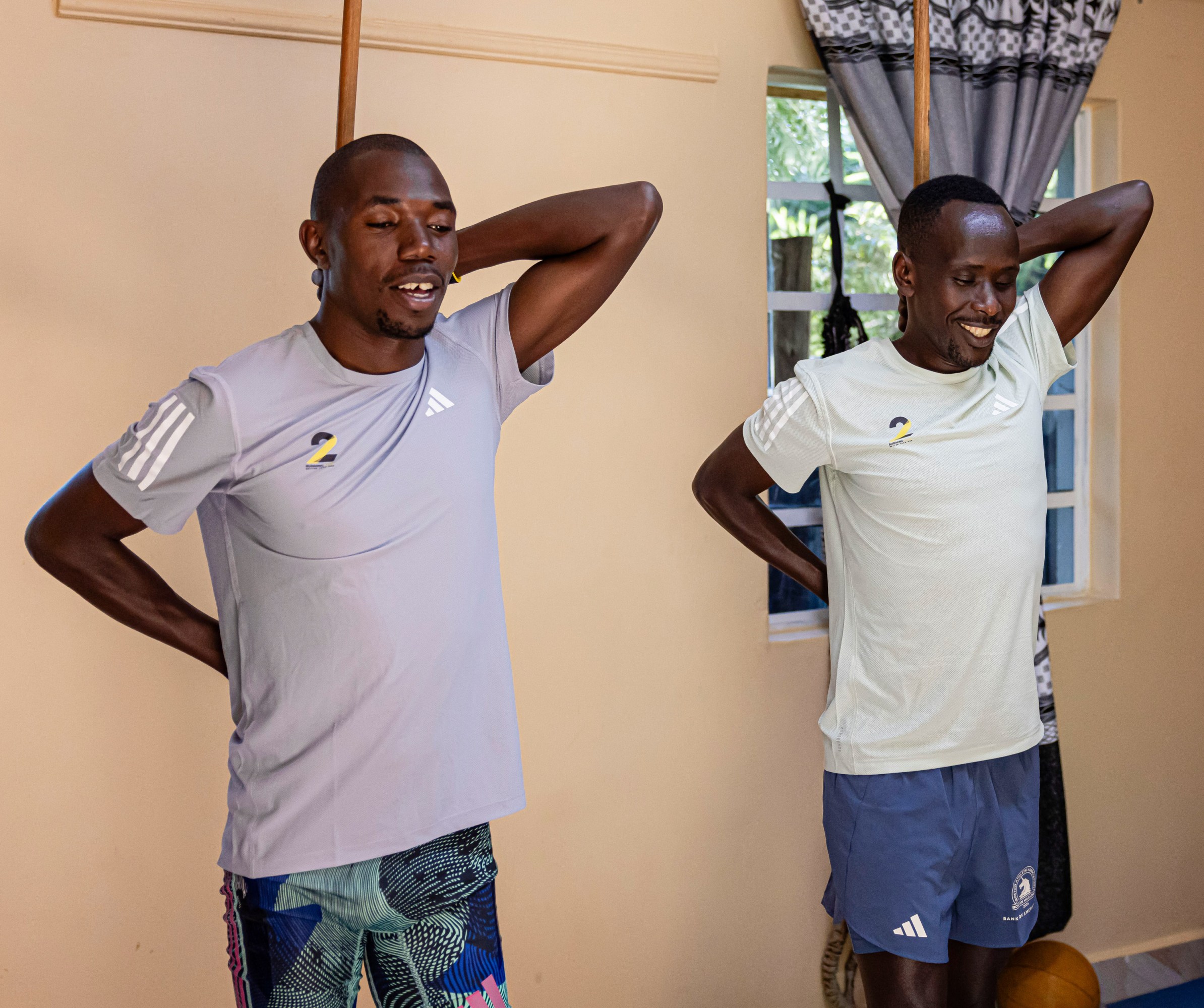
Benson Kipruto (left) and Cyprian Kotut stretch at the 2 Running Club, a training camp sponsored by Adidas in Kapsabet, Kenya. PATRICK MEINHARDT
The trick, for shoe manufacturers, has long been to optimize these properties—and for much of competitive running’s history, they weren’t particularly good at it. As recently as the 1970s, shoes worn for racing had clunky rubber soles and stiff leather or canvas uppers—not so different from the O’Sullivan’s “Live Rubber Heels” that propelled the American Johnny Hayes to victory in the marathon at the 1908 Olympics, the first run at today’s standard distance. The 1975 release of the first shoe with a midsole made from ethylene vinyl acetate (EVA), an air-infused foam, heralded a new generation of footwear that was lighter and bouncier. With a few exceptions, innovations over the next four decades would focus on making EVA shoes as light as possible.
That all changed with the Vaporfly. After its release, most attention focused on its curved carbon-fiber plate, which many suspected functioned like a spring. Research has shown that to be incorrect: while the plate may add some energy-saving stiffness, says Wouter Hoogkamer, a professor of kinesiology at the University of Massachusetts, Amherst, its main benefit appears to be in stabilizing the technology’s most vital component: a thick midsole material made from a foamed polymer known as polyether block amide, or PEBA. Not only is this foam light; tests in 2017 at Hoogkamer’s lab, then at the University of Colorado, Boulder, found that a Vaporfly prototype stored and returned significantly more energy than the leading marathon shoes at the time: the EVA-soled Nike Streak and the Adidas Boost, made with a thermoplastic polyurethane. Hoogkamer’s team also recruited 18 high-performing athletes and tracked their energy expenditure, measured in watts per kilogram of body weight, as they ran for five-minute bouts on a treadmill at different paces in all three. The Vaporfly, they found, improved running economy by an average of 4%—in part by increasing the amount of ground covered with each stride. More recent studies have found a slightly smaller benefit when comparing the Vaporfly and other supershoes with “control shoes” over short distances. However, preliminary data from a Brigham Young University study, which tested subjects during runs lasting an hour, suggests that supershoes may offer a greater running-economy benefit as an athlete progresses through a race, in part because softer foams help reduce muscle fatigue. “A runner with a 3% running-economy benefit in the lab might be at 4% or 5% at the end of a marathon,” says Iain Hunter, a professor of biomechanics who led the research.

Coach Claudio Berardelli estimates that his runners cover at least 60% of their mileage in supershoes. PATRICK MEINHARDT
Although it’s widely accepted that better running economy translates into faster racing, the exact impact on elite performances is subject to uncertainty. At world-record marathon pace, statistical models predict, 4% better running economy would lower time by more than three minutes. But few runners and coaches I spoke with in Kenya believe the technology is worth that much, even as they acknowledge that it’s become essential to competing at the highest level. Many note that footwear has advanced alongside better marathon-specific training and new hydrogel-based sports drinks that make it possible to digest more calories during races. There’s also the scourge of doping: drug-related offenses had left 81 Kenyan athletes ineligible to compete in World Athletics events as of May 1, though Kipchoge has never tested positive, and neither had Kiptum.
Speaking at the track after Kiptum’s January workout, his coach, Hakizimana, estimated that the shoes improved Kiptum’s marathon time by a minute, or perhaps a little more. The technology, he stressed, was only one factor among many that contributed to Kiptum’s rapid ascent. There was the punishing training; the way he’d “attack” with so much confidence in races; the stoicism with which he approached the running lifestyle.
On top of that, there was the influence of the generations before him, who helped transform a land of unparalleled running talent into the home of champions.
To be continued...


 Ren Ecosystem