








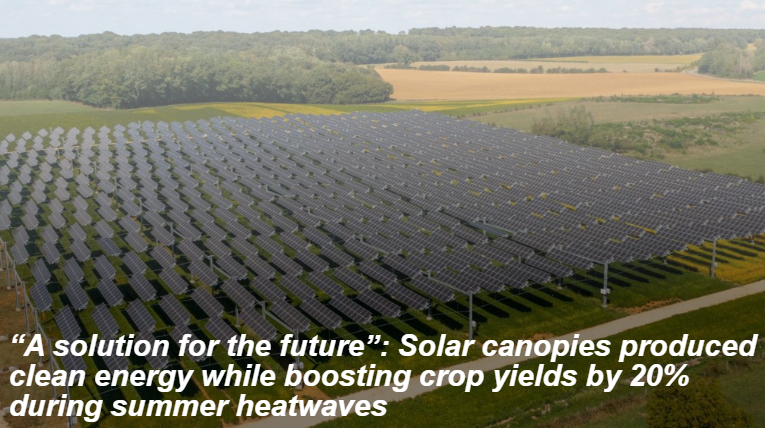
The results of agrivoltaics experiments across France have provided a ray of hope for food systems threatened by increasingly extreme summer weather.
In Amance, a commune in the Haute-Saône department in eastern France, temperatures soared far beyond historical averages this past summer, with the mercury topping 35°C (95°F) for weeks at a time and peaking at 39°C (102.2°F) in late June and again in mid August.
The region’s sweltering summer followed a spring that brought far less precipitation than usual – not a single drop of rain fell on Amance in April.
These are far from optimal conditions for crop cultivation, even for varieties like maize corn that thrive in warm, sunny weather.
However, despite the testing circumstances, one farm in the region was able to boost maize yields by almost 20% on a corn field covered by a canopy of 5,500 solar panels sitting five meters above the ground. The shaded plants also grew 25% higher than those in the control area (200 cm vs. 160 cm).
The panels were installed by TSE, an independent, B Corp-certified organization which markets itself as France’s leader in agrivoltaics (utilizing the same land for agriculture and solar energy generation).
They provided a protective effect, shielding the plants from the worst effects of the extreme heat and helping to reduce evapotranspiration (the combined processes of evaporation and transpiration).
At another site in Chadeleuf, 330 km (205 miles) to the south west of Amance, another solar crop canopy helped to produce a better quality barley yield with negligible reduction in total volume.
TSE’s data show its installation kept temperatures more than 4% lower during the hottest time of the day compared to a control field without a solar panel sunshade, while evapotranspiration was reduced by 20% across the season.
Hervé Malgat, a farmer in Chadeleuf, declared himself “very satisfied” with the results, adding that “agrivoltaics seems to be a solution for the future.”
The Chadeleuf demonstration site also produced enough green energy to meet the demands of 160 households: TSE says its full portfolio of projects (built and planned) has a generation capacity large enough to meet the needs of 260,000 residents.
“These results demonstrate that agrivoltaics can fulfill its purpose: sharing light between agricultural production and electricity generation, even in the context of significant water stress,” said Frédéric Imbert, Director of Agronomy R&D at TSE.
In addition to protecting crop yields, agrivoltaics systems have shown promise on dairy farms and studies have shown elevated solar canopies can have significant ‘habitat-enhancing’ effects by boosting pollinator supply, water retention and carbon storage.


 Ren Ecosystem