








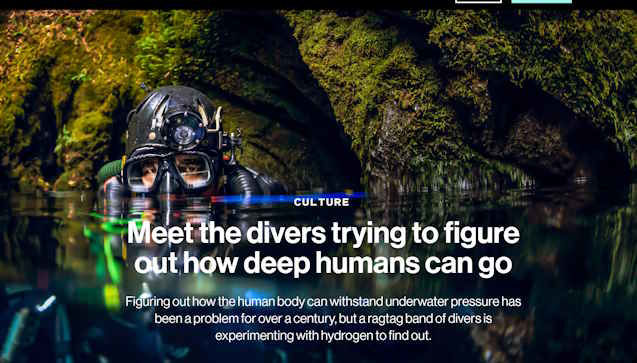
Part 2 of 2. (Photo: SIMON MITCHELL)
continuing from a previous article...
That was the history on Menduno and Clarke’s minds when they began calling up experts in the field to discuss whether it would be possible for a diver outside a chamber to descend beyond 200 meters breathing hydrogen. Each member was an expert in a different element of what would be involved in such a dive—the mechanics of the breathing apparatus, the calculation of gas mixtures, the physiological issues to be overcome as divers coped with cold and pressure. By the end of the first meeting, they had come up with so many potential problems they created what they called a “challenge tree” to organize them; members gravitated toward their areas of expertise and came back to present possible solutions to the group. The tree kept branching; solutions begat new problems.
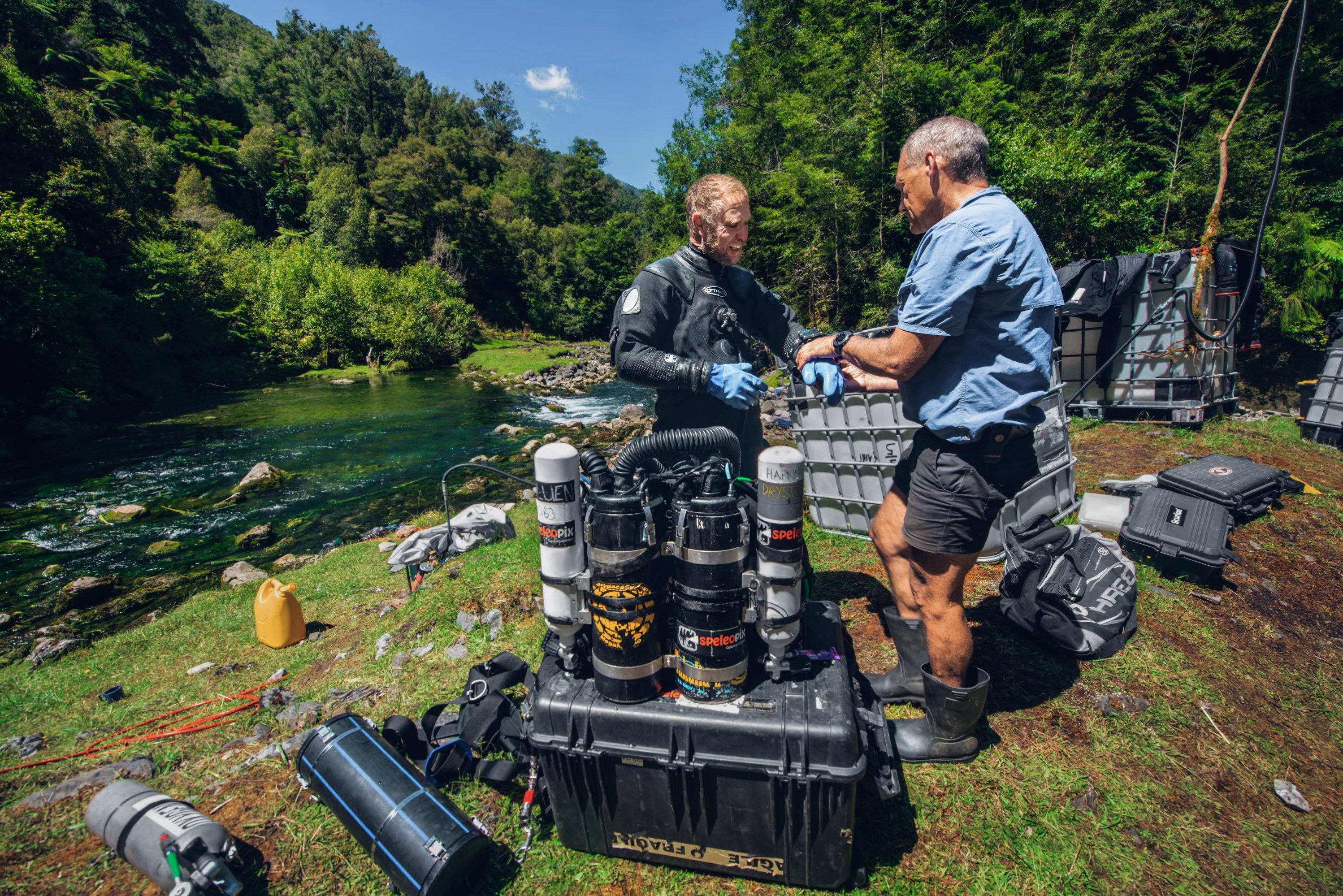
Challen helps Harris gear up in 2020; in front are dual Megalodon rebreathers, one containing an oxygen-helium-hydrogen mix, the other the standard oxygen-helium-nitrogen. Credit: SIMON MITCHELL
Harris joined the working group at Menduno’s invitation. The team of divers he was a part of, the Wetmules, had reached 245 meters at the Pearse Resurgence, the source of the Pearse River in New Zealand, but the cave stretched on, and they wanted to map it. They knew that helium was not going to get them past 300. Hydrogen, however, was nerve-racking. “I don’t really want to be the guinea pig who famously popped under water after switching to hydrogen,” he told the group at the first meeting. “So it’d be nice if we can solve that.”
Hydrogen—as the Hindenburg disaster showed the world—is highly flammable. A spark hundreds of times smaller than the slightest amount of static you can feel on your fingertip would be enough to ignite it. And even if such a spark didn’t cause an explosion, it could still set the gas on fire. “If you’re breathing that mix when it’s burning,” Clarke told the group, “it’s going to be a very unpleasant dive.”
David Doolette, a research physiologist at the US Navy Experimental Diving Unit who had himself dived the Pearse Resurgence in the ’90s, was skeptical but considered himself “dihydrogen-curious,” referring to the molecular structure of hydrogen gas. For one thing, its thermal properties mean divers risk hypothermia. “It’s gonna suck the heat out of your body to a dangerous level,” he told the group. And there was no data available to calculate the appropriate decompression times. “It’s going to be a challenge to do the decompression calculations,” he told the group. “Well, not a challenge doing that—that’d be easy. It’d be a challenge to get them right so that they were safe to dive."
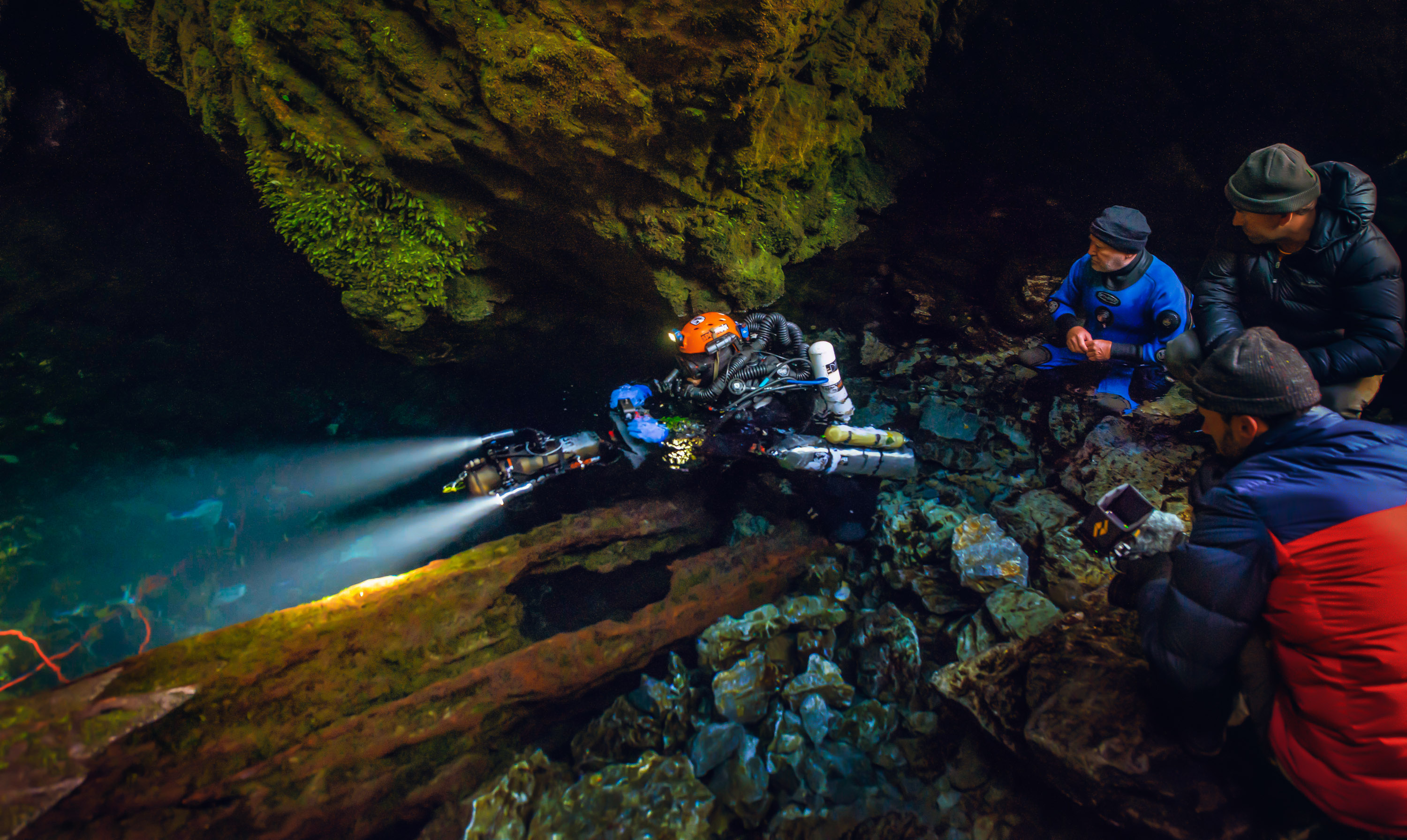
Harris begins the first reported hydrogen rebreather dive, at New Zealand’s Pearse Resurgence in 2023. Credit: SIMON MITCHELL
Others shared his skepticism. Nuno Gomes, a former world-record-holding cave diver, was particularly concerned about decompression. “I think if we’re going to go with this, we’re going to have to progress slowly,” he told the group. “Start with shallow dives and progress to deeper and deeper dives.” But according to Doolette and Stone, the aerospace engineer, it soon became clear that Harris had already decided to try hydrogen in the Pearse Resurgence. At a conference in Australia in 2022, as members of the H2 Working Group met up to talk in person, Imbert said that going beyond 3.5% hydrogen would likely trigger a detonation.
“Harry nods and goes, ‘Well, I don’t think that’s true,’” Stone told me. Imbert asked how he could prove that. “Harry says, ‘Well, last week I did 7% in my pool.’ Everybody perked up.”
Harris had ordered a canister of hydrogen delivered to his suburban home in Adelaide and, as he later explained, “decided to have a bit of a play with it.” He rigged his rebreather for hydrogen and put it in his backyard pool, hoping to contain any potential blast. He filled the rebreather with hydrogen and then, backing way from the pool, began to introduce oxygen. (His dog observed from outside the pool fence; his wife was out.)
When nothing exploded, he started adjusting the ratio of oxygen and hydrogen, becoming confident enough to try using the rebreather himself. His first sip, he later told me, felt light, slippery, and cold. It was almost delightfully easy to breathe. “Hydrogen voice is much sillier than helium voice,” he told me. “And I was pleased the house and the dog were intact.”
The others were amazed. Some were perturbed. “Everybody has to make this decision for themself,” Stone told me. “The Pearse Resurgence is not a place to experiment. When you go in there, you should be using gear and techniques that you know are going to work at that depth. You don’t want to be doing physiological experiments at 300 meters’ depth. That’s what killed all of the other divers who went beyond 200 meters’ depth. So my advice to Harry and anybody else who wants to play this game is the same as what I gave Exley: Go. To. A chamber. Simulate this first.”
“The group was sort of split,” Menduno told me. “I mean, everybody was supportive of Harry, but there were some people in the group that thought: You’re gonna die. Some of the people in the group were upset and worried that their friend was going to go off and do this thing and potentially die.”
Around the first corner of the Pearse Resurgence, the light disappears, as though the dark walls, black marble striated with veins of gray quartz, have absorbed it. The cave sometimes narrows so much that if you stood, you could touch the ceiling. Other parts billow out into enormous chambers. At one point, jagged fingers of rock bristle from the walls. Other, deeper parts of the cave are smooth and almost perfectly round, broken only by dark fissures that lead to unexplored tunnels.
As each section of the cave gets discovered, it receives a name. Going down in February 2023, Harris and Challen passed through the Nightmare Crescent, the Needlebender, the Gargleblaster, Weaver’s Ledge, the Big Room, and finally the Brooklyn Exit. The water was 6 °C and perfectly clear. Aside from the brief hisses and clicks of the rebreathers—the crackle of the solenoid triggering, the sigh of gases being pumped through the loop—there was an otherworldly silence.
At 120 meters, the cave opens up onto a plateau that drops off into an abyss. “At that point it’s like standing on the precipice,” Harris told me. “And it feels like you are really beginning the journey.”
The abyss takes you down 50 meters through a vertical tunnel. By 170 meters, Harris could track where he was on the map in his head, following familiar rock formations. They wanted to preserve their energy and prevent carbon dioxide buildup in their joints, so they limited their movement, relying on underwater scooters to move. They slowly tied off at different points in the descent, working around ropes left behind from dives past, some of which had been installed by Doolette 20 years before.
Harris remembers that even though his mind was absorbed with their strict plan, hypervigilant to any strange noises from his rebreather that could mean failure, he took a moment to pause, thinking: “What if I never got to see this again?”
At 200 meters, Harris introduced the hydrogen. For the next 30 meters he gauged his body’s reaction. He was calm, clearheaded, but even more, he noticed that the light tremors in his hands he usually got at this depth, an early sign of high-pressure nervous syndrome, had disappeared. He looked to Challen, who was using helium, as he tied off the rope: his dive partner’s hands had a visible tremor.
At 230 meters, Harris had done something nobody had done before—swimming freely down to these unimaginable depths and breathing in hydrogen—but his eyes were trained just a little farther, to the unexplored drop only 15 meters away. “I would be lying if I didn’t say I dream about going down there,” he later told an audience in Malta.
Those obsessed with learning how to put the human body under incredible amounts of pressure make up a relatively small community; for the most part, everybody is one degree of separation from everyone else. Clarke, the Navy scientist, and Susan Kayar, a physiologist and expert in decompression who was also part of the H2 Working Group, had both worked at the Navy Medical Research Institute in the ’90s. They had lost touch, but they reconnected after both published novels that included a scene with a hydrogen dive—hers for a rescue mission, his to recover a UFO that had crashed into the sea. “Hers is more realistic in that regard,” Clarke says. “I hadn’t spoken to Susan in 30 years, and then we finally found out: Gee, we’re thinking very much alike!"
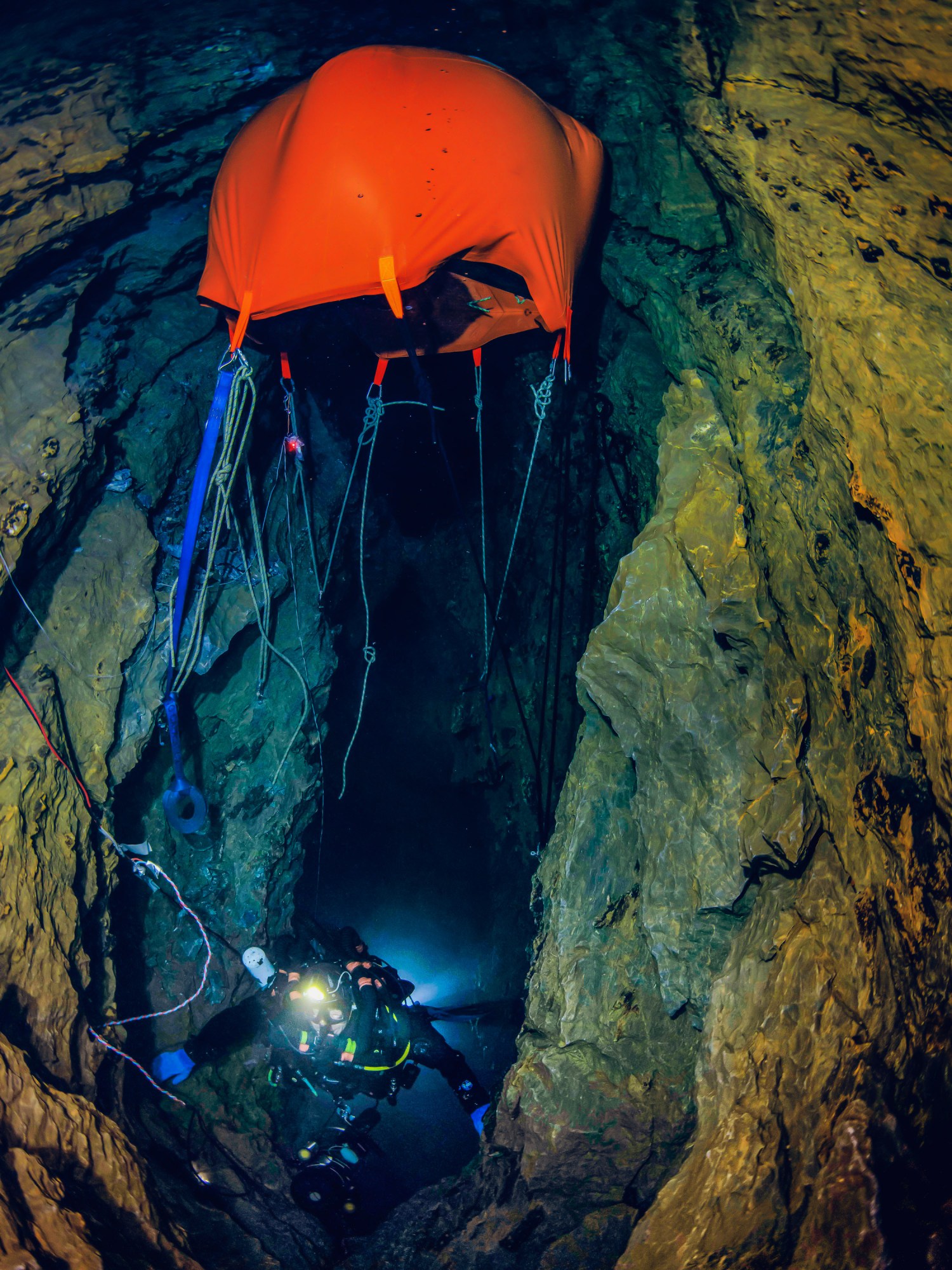
Challen under the seven-meter habitat erected a short distance into Nightmare Crescent in the Pearse Resurgence. The habitat has seats so divers can sit in a dry environment during the final decompression stop. Credit: SIMON MITCHELL
Doolette, the research physiologist skeptical about using hydrogen, has known Harris for more than 20 years, ever since Harris took Doolette’s diving medicine qualification course in Australia. At the time, they were also both working in the hyperbaric medical unit at the Royal Adelaide Hospital. Harris wanted to get more advanced at cave diving and Doolette was a longtime technical cave diver.
Even before the H2 Working Group began meeting, Doolette knew that Harris was thinking about diving with hydrogen. “I knew things were being planned,” Doolette told me. “It probably came as a surprise to some of the workshop, but not to me … I knew it wasn’t theoretical.”
But Doolette felt that testing hydrogen on a deep cave dive was too risky. “There’s a whole hydrogen industry—and their approach is to exclude hydrogen and oxygen from getting near each other. So when you’ve got to mix them together—well, there aren’t even procedures, really,” he says. “I certainly thought it was foolhardy.”
Stone, too, was skeptical of the expedition—for any dive beyond 200 meters, he said, the concept should be tested first. “I’ve been doing this for a long time, and I’ve got a lot of dead friends,” he says.
“We’re moving into the zone where robotics isn’t science fiction,” he continues. “It’s hardware, it’s software—we’re doing it. Is it perfect? No. But it’s a couple years away. We’re close to doing dives longer than the longest human dives, and with a kilometer-depth rating it’ll be far, far beyond even hydrogen diving.”
As a diver, Doolette says, he understands wanting to go where nobody else had been before: “Cave divers and other people explore for the joy of it. A robot’s not gonna get that.” The other draw, he says, is the puzzle of figuring out where the cave is going and how to follow it. And when you finally get into the water, the rest of the world falls away.
A few weeks after the hydrogen dive, Harris gave a presentation to the H2 Working Group, apologizing for “sneaking around a little bit.” He concluded with a caveat: n = 1. “Meaning it has been successful one time,” he said. When the PowerPoint ended, the group applauded. “Just something you can add to your final slide, Harry,” Doolette said. “The probability of survival is greater than zero.”
Doolette was relieved when he learned that Harris had made it back to the surface. “I recognized that it was a pretty groundbreaking, momentous dive,” he told me. “I don’t see the purpose of going deep for the sake of going deep, but if you’re committed to an exploration project and it involves cave diving in pursuit of exploration and discovery, then that’s what you do.”
“There’s always a little temptation to go that little bit further. That’s why we’re doing this stuff,” Challen told me. “We have this defective aspect to our characters that urges us to push on just a little bit more.”


 Ren Ecosystem