







The 2026 FIFA World Cup will not only mark the tournament’s return to North America; it will also become the stage where soccer tests its own future. The United States, Mexico, and Canada will turn their network of stadiums, tech centers, and host cities into an unprecedented laboratory of sports innovation.
What is at stake goes far beyond the sporting spectacle. For the first time, a World Cup will operate on an architecture of data, artificial intelligence, sensors, and immersive interfaces designed to redefine how the world’s most popular sport is played, refereed, and experienced.
With 48 national teams and 104 matches, the tournament demands unprecedented operational precision. But behind this logistical challenge lies a bigger idea: the World Cup as a catalyst for a structural technological leap. These are the five technologies that will debut —or reach their most advanced evolution yet— in 2026.
1. Augmented Refereeing: When Fairness Becomes an Intelligent System
Digital refereeing is not new. VAR has reshaped the competitive ecosystem since Russia 2018. However, 2026 will introduce a broader and more ambitious version of that model. The expansion of video review opens two areas traditionally beyond technological scrutiny: corner kicks and second yellow cards.
FIFA aims to intervene where pure subjectivity once ruled. Determining whether a defender touched the ball before it went out or measuring the true intensity of contact that triggers a booking will no longer depend solely on the human eye. Multi-camera systems and triangulation algorithms will reconstruct scenes in milliseconds, offering a technical and objective reading of actions that historically fueled controversy.
The Coach’s Challenge: A New Politics on the Touchline
But the true revolution will come from the bench. For the first time in a senior World Cup, the FVS system will debut, giving coaches the ability to request a formal review using a limited number of challenges.
The strategic impact is enormous. A coaching staff must decide whether to spend a challenge early or save it for a critical moment late in the match. It builds a bridge between professionalized refereeing and the tactical chess match unfolding in the technical area. It also shifts responsibility: if a team chooses not to challenge a dubious play, it can no longer blame the system. Power dynamics change, redefining the referee-coach relationship.
The “Wenger Law” and the End of the Millimetric Offside
Offside will also undergo its most profound transformation in decades. The so-called “Wenger Law,” designed to favor attacking play, states that a player will be onside as long as any scoring body part is aligned with the second-to-last defender.
To officiate this new frontier, an advanced version of semi-automated technology will model the entire body volume of each player —not just isolated points. This 3D reconstruction will be processed by servers installed directly in stadiums, eliminating latency and accelerating decision-making. The goal: eliminate millimetric errors without slowing the rhythm of the game.
2. Turf Engineering: When the Pitch Is Designed in a Lab
Pitch quality has been one of the most problematic aspects of recent World Cups. But 2026 will inaugurate a completely different system: agronomic standardization. U.S. universities have developed a modular hybrid model that will allow a stadium at altitude in Mexico to offer the same playing surface behavior as an enclosed dome in the United States.
The idea is simple in premise and complex in execution: grow turf in specialized farms, transport it in interlocking modules, and ensure that the joints are imperceptible to a player’s biomechanics. Bounce, shock absorption, resistance, wear patterns—everything calibrated under scientific metrics.
Technology to Protect Players
Standardization goes far beyond aesthetics. Hardness levels are measured to prevent injuries, wear patterns are projected by simulating 104 matches, and specific grass varieties are selected to withstand the rotational friction generated by modern boots.
The pitch becomes a technological asset in itself, engineered to reduce risk, enhance performance, and prevent environmental conditions from creating unfair advantages.
3. The “Trionda” Match Ball: Soccer’s First Truly Smart Ball
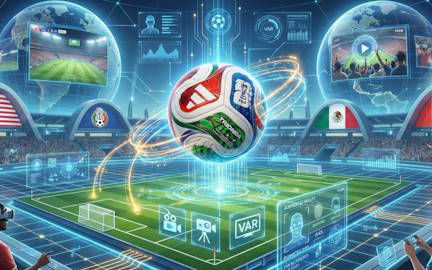
If the pitch is the stage, the ball is the protagonist. And in 2026, the “Trionda” will debut —a match ball that breaks from the tradition of multiple panels, adopting a four-piece structure designed to improve stability, aerodynamics, and predictability.
But the innovation does not stop at its shape. Inside is an IMU sensor that records data at 500 Hz, capable of detecting even the slightest contact and capturing the exact millisecond of impact. This information merges with stadium optical systems to reconstruct actions with surgical precision.
The Ball as a Source of Truth
The sensor will determine whether the ball grazed a foot before going out, whether a goal was valid by millimeters, or the exact point from which a through ball should be analyzed. It is, essentially, soccer’s “black box.”
From an innovation standpoint, this represents a cultural shift: the ball becomes an intelligent device whose technical reading complements —and sometimes corrects— human perception. The game is no longer only played; it is measured, represented, verified.
4. Immersive Broadcasting: Experiencing a World Cup from a New Dimension
Television, even in its 4K form, was no longer enough for FIFA. That is why 2026 marks the leap into immersive fan experiences. “Shared Reality” venues, equipped with ultra-high-definition spherical screens and pitch-level cameras, will propose a new way of attending a match. Spectators will be enveloped in life-scale images with directional audio that replicates stadium atmosphere. It is not a replay; it is a spatial reconstruction of the event.
Spatial Computing: The Match on Your Table
Fans using augmented-reality devices will view the match as a 3D model projected onto their physical surroundings. A play can be examined from the goalkeeper’s viewpoint, the referee’s line of sight, or from an angle impossible in real life.
Soccer storytelling becomes interactive: each fan constructs their own visual narrative.
5. Digital Identity and Biometrics: The Fan as Data
Moving millions of people across three countries requires a human operating system. The World Cup will use facial recognition for stadium access and payments, eliminating lines, printed tickets, and slow transactions. The fan becomes their own entry key, payment method, and security verification. Logistics become fluid—almost invisible.
A “Social World Cup” Built on Data
Mexico will add an extra component: a national app to manage tourist flow and ensure secure ticket resales through digital registration. It is a way to decentralize the experience, distribute visitors toward non-saturated areas, and guarantee that every seat has a verified owner. The World Cup becomes an ecosystem: each fan connected, every movement registered, every service optimized.
The 2026 World Cup Ushers in the Next Era of Sport
The 2026 FIFA World Cup does not aim to be merely the biggest. It strives to become the first to function as an integrated system of sports innovation. Augmented refereeing, scientific playing surfaces, smart balls, immersive broadcasts, and biometric fan management form a coherent ecosystem designed to elevate fairness, excitement, and efficiency.
Soccer is undergoing a historic transition —and North America will be the place where we discover what it means to play, watch, and feel the sport in the decades to come.


 Ren Ecosystem