








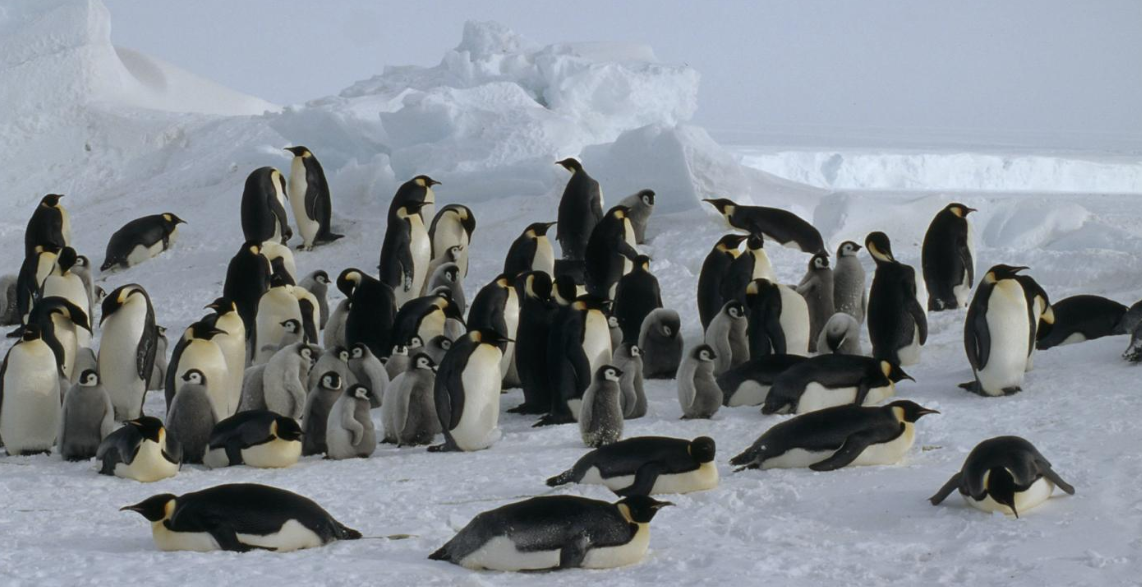
Emperor penguin
(Aptenodytes forsteri)
The emperor is the largest living penguin species standing around 120cm tall. They might look a bit clumsy on land, but penguins are brilliant swimmers. Emperor penguins have the deepest and longest dives of any bird, often reaching depths of over 200 metres. One bird has been recorded at a depth of 565 metres.
Emperors are well adapted to thrive in the freezing conditions of the Antarctic. To preserve heat, they have a dense double layer of feathers – about 70 feathers per square inch – large fat reserves and, proportionally, smaller beaks and flippers compared to other penguins. This all helps prevent heat loss. They also work together to keep warm by huddling up in large groups, shuffling round so each gets a turn in the warm centre.
Populations have declined by almost a quarter since 2009 in a key sector of Antarctica and one colony off the Antarctic Peninsula has disappeared completely.The biggest threat to them right now is climate change due to changes in the sea ice they depend on.
Why are emperor penguins important?
Emperor penguins are a vital part of the Antarctic food chain – they eat creatures like squid and small fish, and are an important source of food for predators like leopard seals and large sharks. They also are a key indicator for climate change and ocean patterns.
By protecting emperor penguins we’re helping look after their ocean environment, which is good for all the wildlife that depends on it.
Top 10 Facts about emperor penguins
1. Ice, Ice, Baby
Wild Emperor penguins are only found in Antarctica. They breed and raise their young mostly on ‘fast ice’, a floating platform of frozen ocean which is connected to the land or to ice shelves. From birth, they spend their entire lives in and around the Antarctic ice, although very rarely vagrants have turned up off the coast of New Zealand.
2. Giants of the Penguin World
Emperors are the biggest of the 18 species of penguin found today, and one of the largest of all birds. They are approximately 120cm tall (about the height of a six year old child) and weigh in at around 40 kg, though their weight does fluctuate dramatically throughout the year.
But they would be dwarfed by the ancient ‘mega-penguins’. Fossils recovered from the Antarctic Peninsula reveal that a colossus species of penguin which lived about 37 million years ago may have stood 2m tall and weighed as much as 115 kg.
3. How many penguins?
Emperors are the least common Antarctic penguin, with an estimate of 595,000 adults in the wild. We're funding research in the Antarctic, because the more we know about these creatures, the better we can protect them. This will encourage the formation of Marine Protected Areas and will help in protecting the species in the face of climate change.
4. Penguins from Space
Emperor penguin colonies have been discovered and counted from space. For the last 15 years, British Antarctic Survey (BAS) scientists have been looking for new colonies by searching satellite imagery for their guano stains on the ice. They have discovered a number of previously unvisited colonies and counted every individual penguin. There are now 66 known emperor penguin colonies around the coastline of Antarctica, with exactly half having been discovered by satellite imagery.
5. Penguin Love
Emperors incubate their eggs during the long dark southern winter months. Courtship displays are intricate but copulation is quick and the female lays a single egg in May or June. She then passes it over to her mate to incubate - and she’s off. She spends the next nine weeks at sea, feeding.
The male carefully balances the egg on his feet for between 65 – 75 days to keep it warm in a specially adapted brood pouch, and off the snow surface, before it hatches. Then out pops a fluffy chick.
6. ‘Baby, its cold outside’
Emperors are uniquely adapted to survive these harsh conditions when temperatures can drop down to a bone chilling -50°C and with winds of up to 200km/hr. They have two layers of feathers, a good reserve of fat and proportionally smaller beaks and flippers than other penguins to prevent heat loss. Emperors also have feathers on their legs, so their ankles don’t get too chilly.
Even their feet are adapted to the icy conditions, containing special fats that prevent them from freezing and strong claws for gripping the ice.
But most remarkably, colonies of adults and chicks work together to huddle for warmth. 5,000 or more tightly packed adults and chicks shuffle around, so each takes a turn - but not too long - on the outside of the huddle where it’s cold. This is in complete contrast to their quarrelsome and territorial neighbours, the Adélie penguins.
7. Dive, Dive Dive!
Emperor penguins are the Olympic divers of the bird world. The deepest recorded dive was 564 m – that’s the equivalent of nearly 2 x the height of the Shard, Europe’s tallest building. And the longest recorded dive was nearly 32 minutes. That’s incredible!
8. Fish suppers
Emperors feed mostly on Antarctic silverfish as well as other species of fish, krill (like Will & Bill from Happy Feet) and some squid. An adult penguin eats about 2-3 kg per day, but on a good day they can eat twice this much to build up their store of body fat for the long winter, or for feeding their chicks.
9. …and Crash Diets
Male emperor penguins will not eat for up to four months, from the time they arrive at the colony to breed until the egg has hatched and the mother returns to feed. They lose almost half of their body weight during this time. They need to rely entirely on the reserve of body fat that they built up during the summer feast to survive the long winter.
10. Vertical Limits
Emperor penguins can climb steep ice cliffs and have been known to breed up on ice-shelves, if the sea ice below fails. In 2013, British and Australian scientists discovered two emperor penguin colonies on ice shelves at Barrier Bay and Larsen C, with a further two temporary colonies on the Shackleton and Nickerson ice shelves. This may be a useful adaptation strategy as Antarctica warms due to climate change, but it might not help them in the long term, if the fast rate of warming continues.


 Ren Ecosystem