









(Lavender flowers at sunset in Provence, France. (© smallredgirl - stock.adobe.com)
Older Adults Did Better On Memory Tests Afer Smelling Shrub, But Only When It Came First
Smelling lavender while learning helped older adults tell similar objects apart, but only when the scent was in the room from the very start of the lesson. When lavender showed up in the second half, after learning began in a plain room, older adults actually did worse on those items. Same scent, opposite results, depending on when it appeared.
Smell and memory have a famous bond. A whiff of perfume or fresh-baked cookies can pull someone straight back to a childhood kitchen, and smell signals travel to the hippocampus, a brain region that helps form new memories. Loss of smell can also be an early sign of cognitive decline. Researchers at Rice University and the University of California, Los Angeles wanted to know whether a pleasant background scent could help the brain keep similar memories from blurring together, and whether age changes the answer. Their results appeared in Frontiers in Aging Neuroscience.
Lavender turned out to be no general memory booster. Across all 47 participants, the scent made no overall difference, and younger adults’ memory did not change with the scent or its timing. Only older adults showed the timing pattern.
Lavender Memory Test Put 47 Adults in Scented and Plain Rooms
Researchers recruited 25 younger adults, ages 18 to 35, and 25 older adults, ages 60 to 85, from Rice University and the Houston community. Technical problems or task errors removed three people, leaving 24 younger and 23 older participants. Everyone was paid $15 an hour, and none had a major history of medical, psychiatric, or substance abuse problems. Eighteen of the 23 older adults were women, and 83% of that group was white. The younger group was more racially mixed and closer to an even split by sex, with 13 men and 11 women.
Participants sorted 128 photos of everyday objects into indoor or outdoor items, 64 in each of two separate rooms. One room had an essential oil diffuser releasing lavender, chosen because it is widely used and generally seen as pleasant. The other had no scent. Participants were randomly assigned to smell lavender in either the first room or the second, and nobody was told what the scent was.
After filling out questionnaires, participants took a memory test in the scent-free room. They viewed 192 images and said whether each was the same as an earlier photo or new or different. Some were exact repeats, some were brand new, and some were lookalikes, such as a blue baby stroller closely resembling one seen earlier. Spotting lookalikes is the kind of detail memory that separates today’s parking spot from yesterday’s. It is thought to lean on the hippocampus, and it tends to get harder with age.
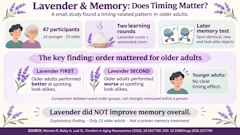
(A study of 47 adults found lavender’s effect on memory depended on timing, and only older adults showed the pattern. (Image by StudyFinds)
Lavender Helped Older Adults’ Memory Only When Smelled First
Across the whole group, lavender did not improve memory for repeated photos or the ability to spot lookalikes. Older adults did worse than younger adults at spotting lookalikes, matching earlier research.
About half the older adults smelled lavender during the first batch of photos, and the rest smelled it during the second. Those in the first group were better at telling lookalikes apart for that batch than older adults who saw it in a plain room. For the second batch, the pattern flipped. Older adults who smelled lavender then did worse than older adults who viewed that batch with no scent. The flip held even after the researchers accounted for how pleasant people found the smell and how well they could smell in general.
Weaker Sense of Smell Tracked With Age, Not Memory Directly
Older adults also scored lower on a standard smell identification test, in which participants identify a series of scents. Nearly everyone recognized onion and smoke, while lemon and lime stumped most people. Five older adults had a severely reduced sense of smell, while seven participants, three older and four younger, had a moderately reduced one. People with weaker smell scores also tended to have more trouble telling lookalikes apart, but the researchers could not establish a direct link between the two. Age appeared to explain most of the connection.
Few participants could even name the scent. Only 8 of 47 identified lavender, seven of them younger adults. Another 31 guessed something related, such as floral or soap, and 8 were unsure or smelled nothing. People who named lavender rated it as the most pleasant, while those who were unsure rated it the least pleasant.
Lavender has not been shown to improve everyday memory. A pattern found in 23 older adults, split into groups of 12 and 11 and tested across two different rooms, is a lead for larger studies, not a reason to buy a diffuser. If scent helps at all, this study hints that it works best when present from the start of learning, which makes timing the question to test next.


 Ren Ecosystem